
 016
Playbook
016
Playbook
The $100K-Day Creative Playbook
Shaun Eng · Elevator Talks
Listen
Episode
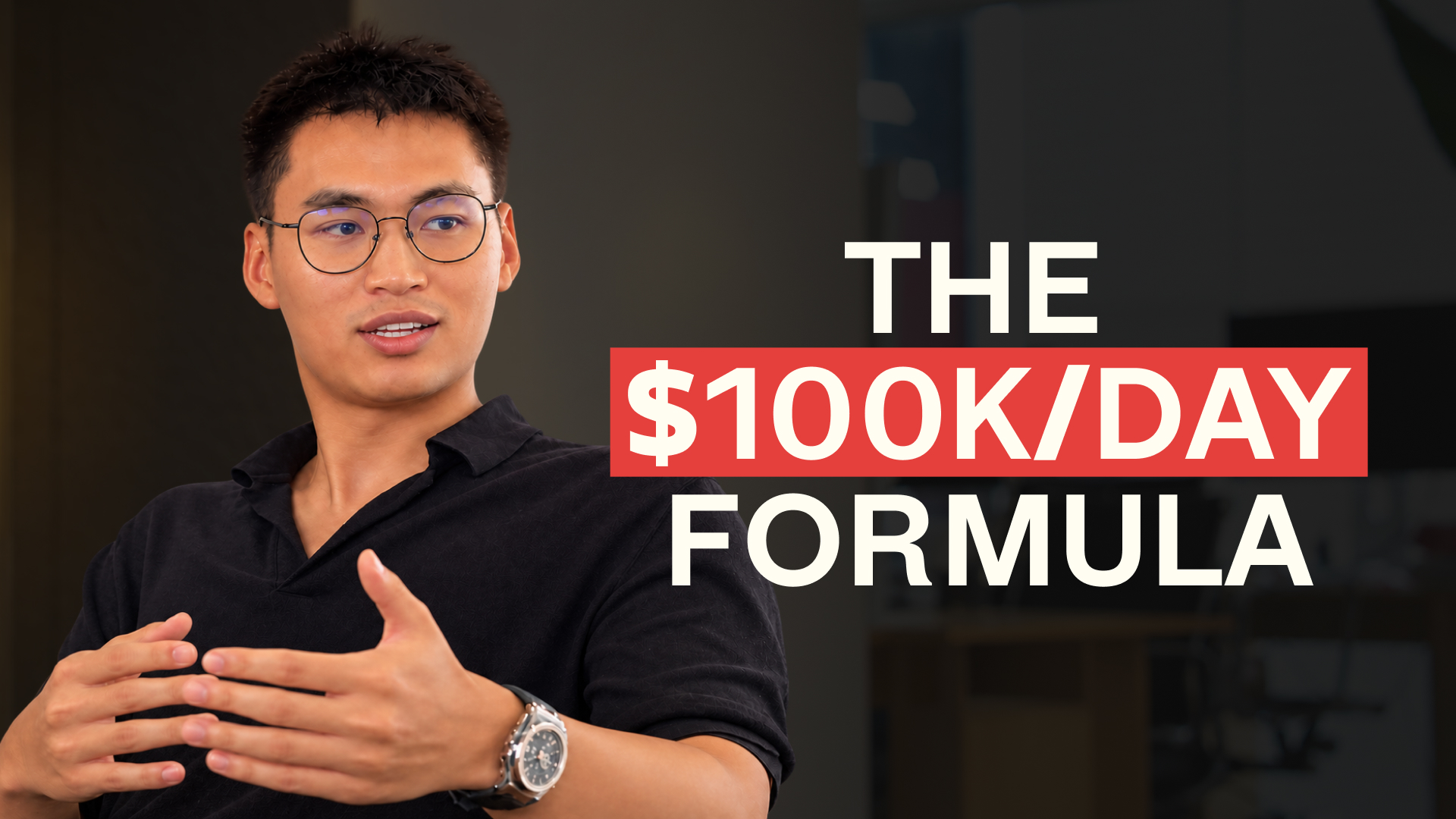
How do you take a brand to $100K days? Shaun Eng has helped more than 50 brand owners reach that milestone. This playbook breaks down the customer research, ad tests and team decisions behind that growth.
Follow
@elevatorgoods on InstagramThe Playbook
The $100K-Day Creative Playbook
You found an ad that sells. How do you build a business that can keep repeating the result?
Shaun Eng has helped more than 50 online brand owners reach $100K days. He works with founders on the customer research, ads and teams behind that growth.
His playbook starts with understanding why an ad works, then building a team that can carry that learning forward. If your team is producing more but sales aren’t following, start here.
1. Understand the Win
The first instinct after finding a winning ad is to make more. Shaun asks the founder to pause: who bought, what did they want, and what made this message matter?
“Women over 54” gives the team a demographic. It does little to explain the customer’s situation, what she has already tried or how she describes the problem. Those details come from research: conversations on forums, Reddit, Facebook and TikTok, read alongside a clear understanding of how the product helps.
Shaun generally starts with one core customer profile and explores different messages for that person. Before the next batch, write down the customer, desire, situation and previous attempts behind the current winner. That explanation gives the next test a starting point.
2. Give the Next Test a Purpose
Put the reasoning on paper before the ad goes live. A spreadsheet or Notion page is enough: what are we testing, who is it for, and why should it work? The written idea also keeps the brief, script and edit pointing in the same direction.
When an ad fails, turn it into a question. Perhaps the hook did not make the problem clear. Perhaps the ad introduced the solution without building enough belief. Test a clearer opening in one version and stronger evidence in another.
These are hypotheses. Shaun acknowledges that the team cannot know the exact cause of every result. The aim is to make a reasoned next move and retain what it teaches you. To do that, the review has to start with the right evidence.
3. Find Out What the Attention Is Worth
Shaun first checks whether the ad is getting spend, what it costs to acquire a customer and what return it produces. He then looks at how many viewers click, watch the opening and keep watching: click-through rate, hook rate and hold rate. A strong soft metric on very little delivery can be misleading.
A strong opening can get people to watch without giving them a reason to buy. Review what the ad promises, who that promise attracts and whether it connects to the product’s value. This is why Shaun looks at how many ads become winners, as well as how many the team produces. Completing a batch tells you little about whether it helped the business.
Once the ad earns the right click, the page has to carry that interest forward.
4. Carry the Promise Through
Imagine clicking an ad because it promises to solve your specific problem, then arriving at a page that talks about everything. The product is still there. The reason you clicked has become harder to find.
Shaun builds landing pages around angles that show promise. Whether the destination is a product page, listicle or advertorial, it should continue the same reason to buy. His examples include winning ads supported by more relevant pages and an apparent loser that improved when the destination matched the message. They are reported results, not guaranteed lifts.
Timing matters. Below roughly $100K a month, a founder still learning what makes the creative work may add too many variables by building a page for every idea. A general product page can be enough while the message is being established.
When an angle earns that investment, read the hook, page opening, evidence and offer together. They should feel like one conversation. Maintaining that clarity gets easier when the people making the content understand the product themselves.
5. Invest in the Creator Who Gets It
Shaun’s strongest creator relationships have led to full-time hires. The starting point is someone already producing useful work, who can use the product and describe the experience in their own words.
His team gives that person a brief: the message, the customer and the intended direction. Product experience gives the creator something real to draw on; feedback helps them interpret the brief more effectively.
That takes more involvement than sending a sample and waiting for files. Shaun describes training calls and showing creators what works and why. The best relationship may deserve deeper investment before the brand adds more names to its roster.
The same principle applies when the footage reaches the editor. Better material helps, but someone still has to understand which moments make the argument.
6. Explain the Decision Behind the Revision
“Change this” gets a revision done. It leaves the editor waiting for the next instruction.
Shaun brings the creative team into the review. Explain why a clip misses the brief, why a hook speaks to the customer or why the ad fails to build belief. Over time, the editor gains a way to judge the work before it reaches the founder.
Make those contributions visible. Shaun tracks who originated an idea, who briefed it and who edited it, alongside details such as the hook, customer profile and landing page. The editor producing the strongest ideas may be ready for a larger role.
He also describes a 3% share-of-spend incentive, including an illustrative 2%/1% split between strategist and editor. The recording does not establish a complete compensation plan or all eligibility conditions. The broader lesson is to connect contribution, results and development.
As the team gains judgment, the founder can begin handing over decisions. That requires a different kind of investment.
7. Build Beyond Immediate ROI
Founders building with their own money learn to be scrappy. Immediate return on investment, or ROI, matters when cash is tight. Shaun sees that instinct become a constraint when every hire or development decision has to pay back immediately.
Stepping away from creative strategy can mean accepting a temporary plateau while the team learns to sustain the work. A senior hire may need time and clear responsibility before their contribution becomes visible. Neither decision is solved by salary alone: strong candidates also need to understand what the business is building and what they can own.
Start with the decisions that repeatedly return to the founder. Identify who could take responsibility and what they would need to succeed. Then look beyond marketing. Separate sourcing from fulfillment, understand lead times and terms, and connect inventory plans to cash forecasts. Shaun describes operations support and a strong fractional CFO, a finance leader working with the business part time, as part of that work.
The purpose is to build a business capable of supporting demand.
8. Earn the Next Expansion
Before adding a second hero product, Shaun wants a team that can sustain the first. Otherwise the new launch splits attention, and keeping either product growing becomes harder.
He takes a similar approach to geography: test for demand, then invest where the signal is promising. He describes running English creative internationally and using the results to choose markets for localization. Language and local buying preferences still matter; the early test helps decide where to build.
A new channel also needs the right capability. Advertising on Meta plays to his strengths. Google has different requirements, and he is explicit that TikTok is not his strongest channel.
Economics remain part of the choice. Shaun prefers an average order value (AOV) above $60 and roughly 70% margin after landed cost. These are his product-selection filters, not net-profit targets or universal rules.
Protect what already works, understand what the next move requires, and test before committing the full team. The process begins where it started: know why something works well enough to make the next decision.
Put It to Work
Start with one winning ad. Write down who it serves and why it works. Use that explanation to brief the next test, review the result with the people who made it, and give someone clear ownership of the next improvement.
Repeat that process until learning no longer depends on every decision passing through you.
Unlock the full playbook
Enter your email to keep reading from section 3.