
 Live
Live
The Trybe Creator Growth Playbook
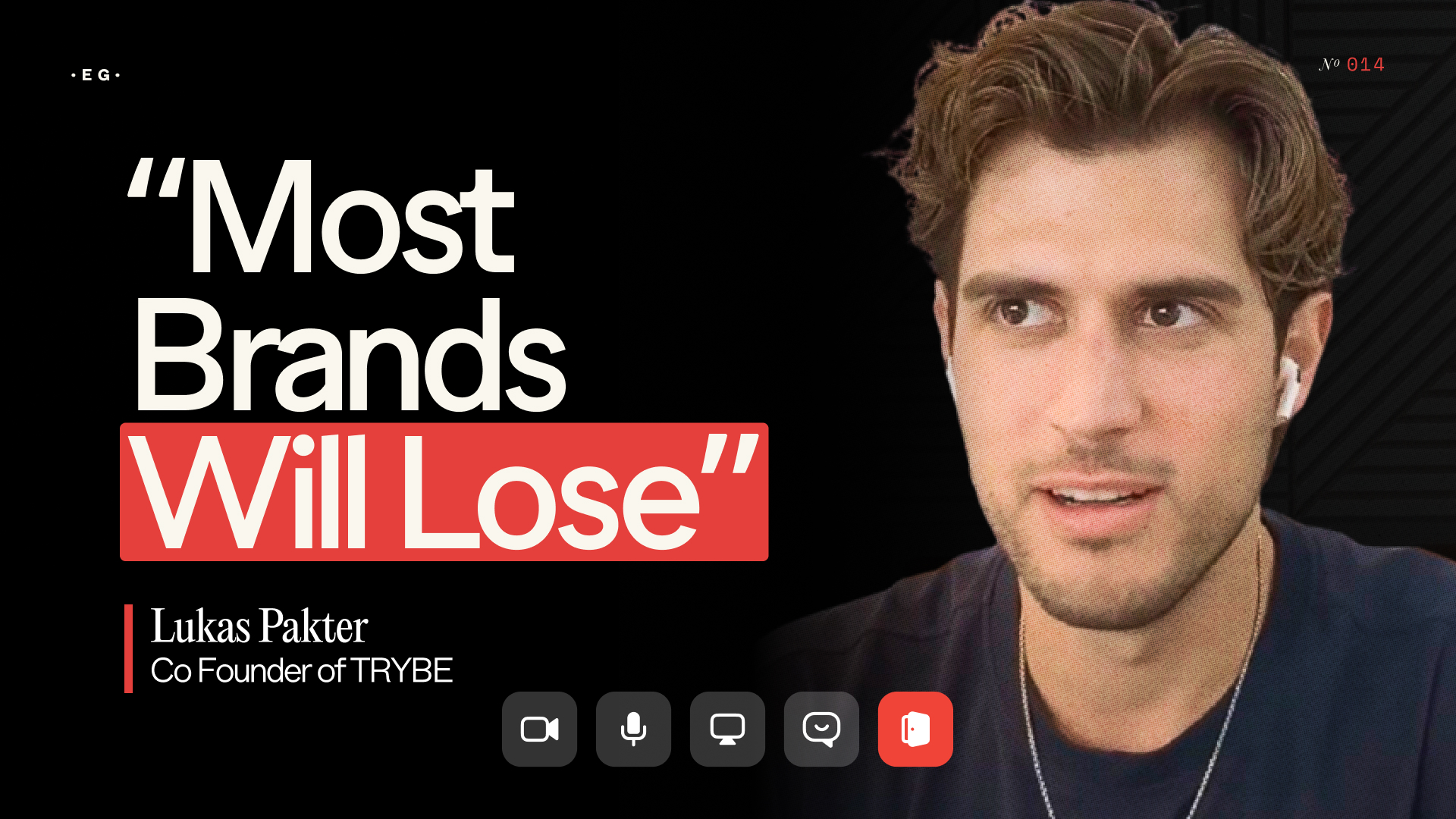
Lukas Pakter · Trybe
Listen
Episode
Lukas Pakter, co-founder of Trybe, on why the best brands stop treating creators like freelancers and start treating them like a sales team — recruited carefully, trained continuously, paid on performance, and built into a long-term acquisition engine.
Follow
@elevatorgoods on InstagramThe Playbook
How to Build a Creator Sales Force
Most brands treat creators like freelancers:
Send a product. Share a brief. Hope the content works.
Lukas Pakter, co-founder of Trybe, treats creators like a sales team. They are recruited, trained, paid and developed around one outcome:
Producing content that profitably sells the product.
Here is how he does it.
1. Build the Creative Foundation First
Creator-led growth will not fix a brand that does not understand its own creative.
Before recruiting creators, the founder or internal team needs to know:
- Which customer problems drive action
- Which hooks hold attention
- Which benefits matter most
- Which creator profiles feel believable
- Which formats and environments perform
Lukas recommends producing the first 300 creatives internally.
The number is not the point. The goal is to develop enough pattern recognition to teach someone else what good content looks like.
As a general benchmark, Lukas believes brands should be doing at least six figures per month in Meta revenue before building a serious creator program.
There needs to be enough money in the system for creators to see meaningful upside.
2. Train Creators Instead of Chasing Proven Talent
The best creators already have unlimited opportunities.
They are being approached by every brand, can command larger retainers and will naturally choose the company offering the most upside.
Competing for them becomes a bidding war.
Instead, find people earlier in their journey who have:
- Strong customer fit
- Clear motivation
- Coachability
- Consistent output
- A genuine interest in the category
You are not looking for finished creators.
You are looking for people worth developing.
When you train them successfully, their relationship with the brand becomes much harder for competitors to copy.
3. Onboard Them Like Salespeople
Most companies send creators products and tell them to start filming.
That is the equivalent of hiring a salesperson, handing them an unfamiliar product and asking them to start selling immediately.
Creators need to understand:
- What makes the product different
- Who the customer is
- Which problems it solves
- Why people buy
- Which objections prevent purchase
- Which messages and angles already work
- What great content looks like for the brand
Give every creator:
- Product education
- Customer research
- Winning ad examples
- Creative briefs
- Production standards
- Direct feedback
The goal is not to make creators follow scripts.
It is to give them enough understanding to sell naturally.
4. Give Creators Enough Attempts to Win
A creator cannot be properly judged after five videos.
Lukas referenced Meta data suggesting that roughly one in 25 ads becomes a winner on average. For a younger brand, the success rate may be lower.
That means creators need enough output to improve and enough attempts to find a winner.
A simple structure could be:
30
videos / month
Minimum standard
60
videos / month
Retainer eligibility
90–100
videos / month
High-output tier
The exact numbers depend on your economics.
The principle is more important:
Do not expect creators to improve without enough repetitions.
5. Combine Retainers With Performance Pay
Pure performance compensation protects the brand, but it gives creators little support during the period when they are still learning.
Retainers fund that learning curve.
A basic structure could be:
Produce 30 videos per month to remain in the program. Produce 60 videos per month to unlock a $2,000–$3,000 retainer. Earn additional commission based on the revenue your ads generate.
The retainer provides enough security for the creator to focus on the brand.
The commission preserves the upside.
You are not paying for mediocre content forever. You are investing in the repetitions required to eventually produce winning content.
6. Make Creator Earnings a Core Metric
Most brands ask:
How cheaply can we get more content?
The better question is:
How much can our best creators earn with us?
When creators make more money, they:
- Produce more
- Improve faster
- Invest in better equipment
- Hire editors
- Study successful content
- Stay with the brand longer
Lukas said his creator commissions can equal approximately 25% of ad spend.
Not every brand needs to operate at that level, but he believes creators should receive at least roughly 10% of ad spend across commissions and retainers for a robust program.
If a company spends $1 million on ads but only $40,000 reaches creators, its budget may be backwards.
Sometimes the better move is to:
- 01Reduce ad spend.
- 02Increase creator commissions.
- 03Put the strongest creators on retainers.
- 04Improve creative output.
- 05Scale spend again once the content performs.
More media spend will not fix weak creative.
7. Coach Creators Every Week
A creator program is a training system, not a sampling program.
Run regular calls to:
- Review winning ads
- Break down failed ads
- Compare creator performance
- Share customer insights
- Improve hooks and messaging
- Fix production issues
- Reinforce product knowledge
In the beginning, creators need direct support.
Over time, the strongest creators should become better at producing content than the founder.
Those creators can then become coaches, creative strategists and program managers.
8. Move the Message From “I” to “You”
Influencers can talk about themselves because their audience already cares about them.
UGC creators usually do not have that advantage.
The customer does not care what the creator likes. They care about what the product will do for them.
Weak:
“I like wearing this shirt to the gym.”
Stronger:
“If you overheat while training, this fabric helps keep you cooler without sacrificing the fit.”
Every ad should answer:
- Why should the customer care?
- What problem disappears?
- What outcome becomes easier?
- Why is this product different?
UGC should feel like a useful customer recommendation—not a scripted endorsement.
9. Scale Quality and Quantity Together
Quality versus quantity is the wrong debate.
You need both.
A small number of ads eventually fatigues. High volume without meaningful variation produces noise.
Every new ad should introduce a different:
- Customer experience
- Hook
- Problem
- Benefit
- Use case
- Environment
- Format
- Level of awareness
Lukas’s brand produces approximately 5,500 creator ads per month, with a goal of reaching 10,000.
Most brands should not copy that number immediately.
They should build a system capable of increasing output without sacrificing relevance.
10. Let Meta Choose the Winners
Do not force spend behind weak content to make creators feel valued.
Use retainers to support creators while they improve. Let the media budget support the content most likely to reach the brand’s performance target.
Lukas’s structure:
- 01Create a campaign for the product.
- 02Place creator ad sets underneath it.
- 03Set the budget and required return at campaign level.
- 04Upload a large pool of creator content.
- 05Let Meta allocate spend toward likely winners.
- 06Use the results to coach creators.
Some creators will receive little or no spend.
The solution is not to force budget into their ads.
The solution is to show them what winning creators are doing differently.
11. Retain the People You Develop
Recruitment creates the program.
Retention creates the moat.
Every time you train a creator, you make them more valuable. If they leave six months later, you may have funded someone who now produces better content for your competitors.
Retention comes from:
- Fair compensation
- Direct founder access
- Useful feedback
- Leadership opportunities
- Relationships inside the group
- Long-term earning potential
Your best creator may eventually become your creator coach, creative strategist or program manager.
Give the strongest people a path to grow inside the system.
12. Do Not Cut High-Effort Creators Too Early
Early success can be misleading.
One creator may find a winner quickly and stop improving. Another may struggle for months but continue producing, attending calls and applying feedback.
Lukas said eight out of ten of his eventual top creators made nothing during their first six months.
One of his weakest creators received a $3,000 monthly retainer for almost a year before breaking through.
He later:
- Earned around $78,000–$79,000 in one month
- Produced one video worth approximately $280,000
- Became the person running the creator group
The lesson is not to retain every underperformer forever.
Separate creators who lack commitment from creators who are committed but still developing.
Cut the inconsistent and uncoachable.
Be more patient with the people doing the work.
The Playbook in Eight Steps
- 01Prove the product and learn creative internally.
- 02Recruit motivated creators with strong customer fit.
- 03Teach them the product, customer and winning messages.
- 04Set enough output for creators to improve and find winners.
- 05Combine retainers with performance-based upside.
- 06Coach creators and review their work every week.
- 07Let Meta allocate spend toward the strongest ads.
- 08Turn top creators into long-term operators.
The Trybe playbook is not about finding more people who can film videos.
It is about developing people who can sell.
One salesperson can call one customer.
One creator can make a video that reaches millions.
Unlock the full playbook
Enter your email to keep reading from section 3.